


Zhao XU and Hao WANG
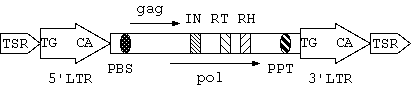
The typical structure of a full-length LTR retrotransposon is shown in Figure 1:
~6bp short
direct repeat string flanking the 5' and 3' extremities of an
element. It is the sign of insertion of transposable elements.
~18bp
sequence complemented to the 3' tail of some tRNA. The site is very
important because tRNA binding process is the first step of
initiating reverse transcription.
~15 bp in length. Like PBS, this region is important
for reverse transcription.
>CHR1 19971009 Chromosome I Sequence
CCACACCACACCCACACACCCACACACCACACCACACACCACACCACACCCACACACACA
CATCCTAACACTACCCTAACACAGCCCTAATCTAACCCTGGCCAACCTGTCTCTCAACTT
ACCCTCCATTACCCTGCCTCCACTCGTTACCCTGTCCCATTCAACCATACCACTCCGAAC
... ... ... ...
TGATGGAGAGGGAGGGTAGTTGACATGGAGTTAGAATTGGGTCAGTGTTAGTGTTAGTGT
TAGTATTAGGGTGTGGTGTGTGGGTGTGGTGTGGGTGTGGGTGTGGGTGTGGGTGTGGGT
GTGGGTGTGGTGTGGTGTGTGGGTGTGGTGTGGGTGTGGTGTGTGTGGG
>CHR2 19970727 Chromosome II Sequence
AAATAGCCCTCATGTACGTCTCCTCCAAGCCCTGTTGTCTCTTACCCGGATGTTCAACCA
AAAGCTACTTACTACCTTTATTTTATGTTTACTTTTTATAGGTTGTCTTTTTATCCCACT
TCTTCGCACTTGTCTCTCGCTACTGCCGTGCAACAAACACTAAATCAAAACAATGAAATA
... ... ... ...
>Sequence: CHR2 Len:813138
[1] CHR2 Len:813138
Location : 29632 - 35590 Len: 5959 Strand:+
Score    : 9 [LTR match score:1]
Status   : 11111111100
5'-LTR   : 29632 - 29963 Len: 332
3'-LTR   : 35259 - 35590 Len: 332
5'-TG    : TG , TG
3'-CA    : CA , CA
TSR      : 29627 - 29631 , 35591 - 35595 [ATAAT]
Sharpness: 0.479,0.52
Strand + :
PBS   : [17/22] 30031 - 30052 (ThrAGT)
PPT   : [11/15] 35215 - 35229
Domain: 31889 - 32416 [possible ORF:31193-35236, (IN (core))]
Domain: 33779 - 34387 [possible ORF:31193-35236, (RT)]

Details of exact match pairs:
35259-35472[214] (1) 35474-35590[117]
29632-29845[214] (1) 29847-29963[117]

Details of the LTR alignment(5'-end):
                            |35259
CATTAGATCTATTACATTATGGGTGGTATGTTGGAATAAAAATCAACTATCATCTACTAAC
||  ||  |    ||| |||   |    |||*|||||||||||||||||||||||||||||
CA--AG--C----ACA-TAT-AAT----TGTTGGAATAAAAATCAACTATCATCTACTAAC
                  **-***----|29632

Details of the LTR alignment(3'-end):
                        35590|*****
ACAATTACATCAAAATCCACATTCTCTACAATAATAGAA--TAATGAA-CGATAACACACA
|||||||||||||||||||||||||||||* |  |||    || ||   || | ||
ACAATTACATCAAAATCCACATTCTCTACA-TGGTAGCGCCTA-TGCTTCGGTTACTT---
                        29963|

Details of the PBS alignment(+):
tRNA type: ThrAGT
GCTTCCAAT----CGG-ATTTG
|||||||||    ||| |||||
GCTTCCAATTTACCGGAATTTG
|30031

Details of PPT(+):
AACAAACAAATGGAT
|35215
While most of the output is straight forward, there are some fields need further explanation.
 )
is the sequence similarity between 5'LTR and 3'LTR. It is a decimal
between 0 and 1.
)
is the sequence similarity between 5'LTR and 3'LTR. It is a decimal
between 0 and 1.
 , Sharpness of
the center position is:
, Sharpness of
the center position is:

where  and (
and ( ) are the number of matched
bases in left half and right half window respectively. Put the
center position at the LTR boundary to get the sharpness.
) are the number of matched
bases in left half and right half window respectively. Put the
center position at the LTR boundary to get the sharpness.
|' line points out
putative boundary after the second run boundary decision (see
Strategy Section). Other 4~6 continuous asterisks show the
positions of putative TSR.
>Sequence: CHR2 Len:813138
[1] CHR2 Len:813138
Location : 29632 - 35590 Len: 5959 Strand:+
Score    : 9 [LTR match score:1]
Status   : 11111111100
5'-LTR   : 29632 - 29963 Len: 332
3'-LTR   : 35259 - 35590 Len: 332
5'-TG    : TG , TG
3'-CA    : CA , CA
TSR      : 29627 - 29631 , 35591 - 35595 [ATAAT]
Sharpness: 0.479,0.52
Strand + :
PBS   : [17/22] 30031 - 30052 (ThrAGT)
PPT   : [11/15] 35215 - 35229
Domain: 31889 - 32416 [possible ORF:31193-35236, (IN (core))]
Domain: 33779 - 34387 [possible ORF:31193-35236, (RT)]
The five parameters control alignment algorithm. Denote gap open
penalty as  , gap extend penalty as
  , gap end
penalty as
, gap end
penalty as  , match score as
  and mismatch score
as
and mismatch score
as  , then global and local alignments score are :

 is the number of match bases;
  the number of unmatched bases; and
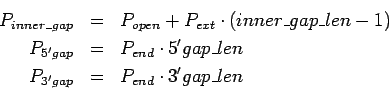
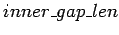 is the length of gap minus 2 (end bases).
Usually, is greater than .
is the length of gap minus 2 (end bases).
Usually, is greater than .
Distance between LTRs is:

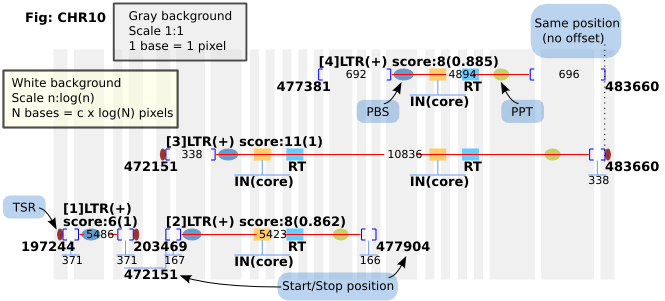
The three parameters control the extension of LTRs. An example of 2
neighbouring LTR pairs is shown in Figure 3. If
![$s[i_b\ldots m_e]$](img18.gif) and
and
![$s[j_b\ldots n_e]$](img19.gif) are similar enough, we extend LTRs from
are similar enough, we extend LTRs from
![$s[i_b\ldots i_e]$](img20.gif) and
and
![$s[m_b\ldots m_e]$](img21.gif) to
and
.
to
and
.
 and
and  are pre-sorted so that
  ,
,  and
and  . Since and are two exact match
pairs, we know
. Since and are two exact match
pairs, we know

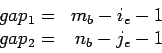
 , number of base differences resulting from
extension, as
, number of base differences resulting from
extension, as

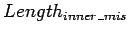 is the number of different(mismatches
and indels) bases from global alignment of
is the number of different(mismatches
and indels) bases from global alignment of
![$s[i_{e}+1\ldots
m_{b}-1]$](img33.gif) and
and
![$s[j_{e}+1\ldots n_{b}-1]$](img34.gif) . The similarity of merged
loci is then:
. The similarity of merged
loci is then:

When LTR_FINDER decides whether two neighboring pairs should be
merged, it first calculates , make sure that it does not
exceed the value of extension max gap, then calculates  .
If
.
If
 , pair extension will stop here,
![$P_1\{s[i_b\ldots i_e], s[j_b\ldots j_e]\}$](img38.gif) will be reported as a candidate for LTR element; If
will be reported as a candidate for LTR element; If
 , new pair and inter-pair
regions will be linked to the previous one to construct a longer new
pair
, new pair and inter-pair
regions will be linked to the previous one to construct a longer new
pair
![$P\{s[i_b\ldots m_e], s[j_b\ldots n_e]\}$](img40.gif) , and LTR_FINDER continues to find next neighboring pairs; if
, and LTR_FINDER continues to find next neighboring pairs; if
 , it means we are not sure whether continue to extend or stop. So LTR_FINDER first report a LTR element candidate
while at the same time, the extension process will continue.
, it means we are not sure whether continue to extend or stop. So LTR_FINDER first report a LTR element candidate
while at the same time, the extension process will continue.
Running time of LTR_FINDER is very sensitive to this parameter. The
program only selects pairs that are longer than this value to do
further processes from all exact match pairs detected. If a very
small value is given, LTR_FINDER will spend much time on randomly
matched short sequences. We use P-value to estimate proper value of
-p, that is, the probability of exact match of length longer than
 occurs if 2 sequences are drown randomly. In Waterman
1989(, ), under independent letter model, using
asymptotic extreme value distribution, P-value were worked out
analytically. Now if one assign the P-value, length can be deduced.
From experiments, 20 is appropriate in most situation, and we
suggest not using of value less than 15.
occurs if 2 sequences are drown randomly. In Waterman
1989(, ), under independent letter model, using
asymptotic extreme value distribution, P-value were worked out
analytically. Now if one assign the P-value, length can be deduced.
From experiments, 20 is appropriate in most situation, and we
suggest not using of value less than 15.
When aligning tRNA 3' tail 18nt string to the inter-LTR sequence, if LTR_FINDER finds an alignment that match length exceeds this threshold, it will report this region as a putative primer binding site.
To predict primer binding site, we need tRNA sequences, especially the 3' end 18nt of each sequences. LTR_FINDER can load tRNA of different species. A good tRNA set can be found at Genomic tRNA Database (http://lowelab.ucsc.edu/GtRNAdb/). Our database was download from Genomic tRNA Database on 2007-07-17. Here is an example of required format:
>Athal-chr4.trna25-AlaAGC (13454563-13454635)
GGGGATGTAGCTCAGATGGTAGAGCGCTCGCTTAGCATGCGAGAGGCACGGGGATCGATA
CCCCGCATCTCCA
LTR_FINDER uses the string after the last minus sign in sequence identifier field as the tRNA type name. In this example, `AlaAGC'.
This parameter is a directory name. LTR_FINDER can predict protein domains by calling ps_scan, which can be obtained from ExPASy-PROSITE (http://www.expasy.org/prosite/). User should place data file `prosite.dat' and ps_scan in this directory. If this parameter is enabled, LTR_FINDER will call them and report these protein domains if they are detected.
This is the threshold for LTR retrotransposon score. Models that have higher scores are output.
LTR_FINDER calculates sharpness for both 5' and 3' extremities of putative elements. Both of them must be greater than the lower threshold and one greater than the higher threshold.
This parameter controls the output format:
| Value | Format |
| 0 | Full output |
| 1 | Summary output |
| 2 | Table output(not available on web) |
LTR_FINDER can output alignment details of LTR boundaries (left to
120bp and right to 80bp relative to boundaries). Users are allowed
to assign the output length by setting this parameter. The whole 200
bp alignment is output when it  .
.
This parameter is ID of one sequence in a multi-fasta file. When enabled, only sequences with this ID will be processed.
The parameter controls output by sequence tag status. It is a binary string of 11 bits. From left to right, bits denote the status of following signals: TG in 5' end of 5'LTR, CA in 3' end of 5'LTR, TG in 5' end of 3'LTR, CA in 3' end of 3'LTR, TSR, PBS, PPT, RT, IN(core), IN(c-term) and RH. 1 means reported models should containing the signal and 0 ignoring searching it. when used, the program will only report models whose status of sequence tags match it.
With this parameter, LTR_FINDER will try to mask highly repeated regions defined by: the same exact match pair repeat 14 more times within 3000bp. By using this parameter, LTR_FINDER can perform much more quickly on sequences which have centriole or telomere region.
This document was generated using the LaTeX2HTML translator Version 2008 (1.71)
Copyright © 1993, 1994, 1995, 1996,
Nikos Drakos,
Computer Based Learning Unit, University of Leeds.
Copyright © 1997, 1998, 1999,
Ross Moore,
Mathematics Department, Macquarie University, Sydney.
The command line arguments were:
latex2html -up_url http://tlife.fudan.edu.cn/ltr_finder -up_title 'LTR_FINDER Home Page' -transparent -antialias_text -antialias -image_type gif -local_icons -split 0 help
The translation was initiated by on 2009-04-09

![$P_1\{s[i_b\ldots i_e], s[j_b\ldots j_e]\}\ and \ P_2\{s[m_b\ldots m_e], s[n_b\ldots n_e]\}$](img22.gif)